2026-07-31T13:13:50.262Z ·
Alternatives to Dental Implants
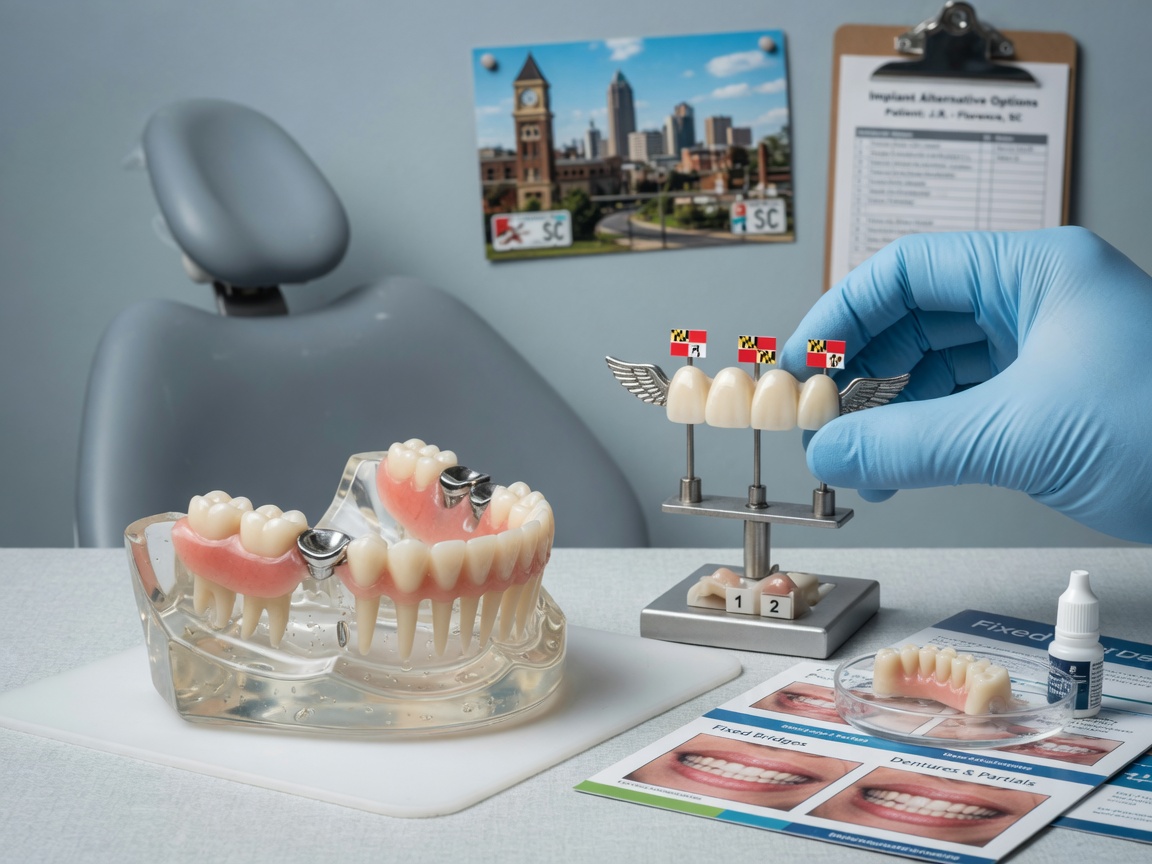
The main alternatives to dental implants are a fixed dental bridge anchored to adjacent teeth, a removable partial denture, a full denture for complete arch replacement, and a resin-bonded or Maryland bridge for front teeth. Each costs less upfront than an implant. None of them preserve the jawbone at the site, which is the structural advantage implants hold over every alternative.
Fixed Dental Bridge
A traditional bridge spans the gap by crowning the teeth on either side and suspending a false tooth between them. It's fixed, functions well, and typically costs less than an implant upfront.
The cost is borne by the neighboring teeth. They must be filed down to receive crowns, permanently, even if they were perfectly healthy. Bridges also typically need replacing every ten to fifteen years, so the lifetime cost comparison against an implant is much closer than the initial quotes suggest.
Removable Partial Denture
A partial denture replaces several missing teeth with a removable appliance clasped to remaining teeth. It's the least expensive option by a wide margin and requires no surgery.
The drawbacks are real: reduced chewing efficiency, clasps that may be visible, movement during eating, and the need to remove it for cleaning. The clasps also place stress on the anchor teeth over time. As an interim solution during implant healing, or as a genuine budget solution, it has a legitimate place.
Full Dentures
For a completely edentulous arch, conventional dentures remain the lowest-cost route. Modern dentures fit better than their reputation suggests, particularly upper dentures which get suction from the palate.
Lower dentures are the persistent problem. With no palate to seal against and a shrinking ridge to sit on, they move. This is precisely why implant-supported dentures exist, and why the comparison with conventional dentures is worth reading in full in our denture comparison.
Resin-Bonded (Maryland) Bridge
A Maryland bridge bonds a false tooth to the back of adjacent teeth using thin wings, without crowning them. It's conservative, reversible and inexpensive relative to an implant.
It works best for a single front tooth where chewing forces are lighter. Debonding is the common failure mode, and it isn't suited to molars. For a young patient whose jaw is still growing and who isn't yet an implant candidate, it's often the right interim answer.
The Bone Loss Argument
Here's what none of the alternatives address. When a tooth root is removed, the bone that held it begins to resorb, most rapidly in the first year. A bridge or denture sits on top of that process without slowing it.
Over years, that resorption changes facial structure, complicates denture fit, and makes future implant placement harder, sometimes requiring bone grafting that wouldn't have been necessary if an implant had gone in earlier. An implant transmits chewing force into the bone and largely prevents this.
When an Alternative Is the Better Choice
When the adjacent teeth already need crowns for other reasons, a bridge gets you two outcomes for one procedure. When a patient can't undergo surgery, or is a heavy smoker unwilling to stop, implant success rates drop enough that alternatives become more sensible. When budget genuinely rules implants out, a well-made partial beats an untreated gap.
We'd rather say that plainly than pretend implants are the answer to every case. Our cost guide exists so you can make that call with real numbers.
The Middle Ground
Mini implants occupy useful territory between a conventional implant and a removable denture. They cost substantially less, require less surgery, and can stabilize a lower denture that currently moves.
Implant-supported bridges are the other efficiency: two implants carrying three or four teeth costs far less than one implant per missing tooth, without touching the healthy neighbors the way a traditional bridge does.