2026-07-27T13:13:50.262Z ·
Snap-In Dentures vs All-on-4: Which Is Right for You?
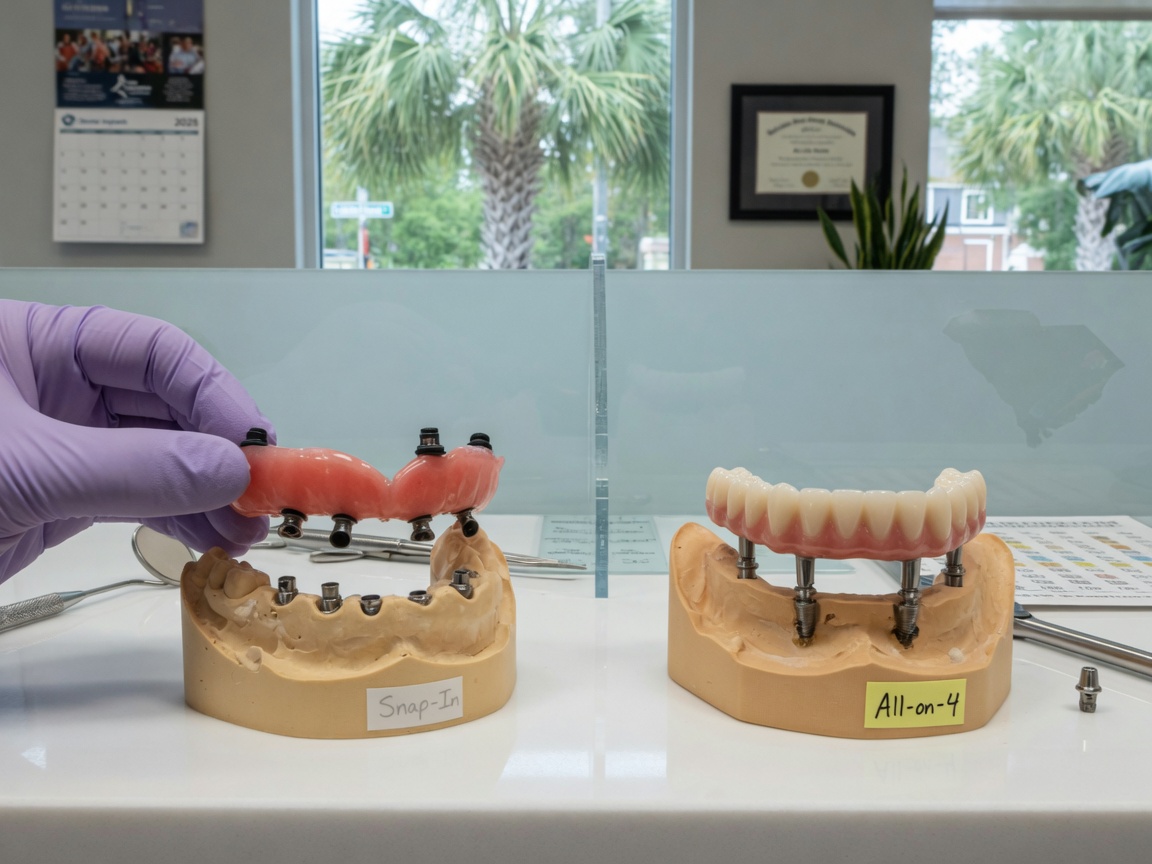
Snap-in dentures are removable overdentures anchored by two to four implants, typically costing $6,000 to $15,000 per arch. All-on-4 is a fixed bridge permanently secured to four angled implants, typically $20,000 to $30,000 per arch, which you never take out. The core decision is whether the lower cost and easier cleaning of a removable appliance outweighs the stability and feel of fixed teeth.
How Snap-In Dentures Work
Two to four implants are placed, each fitted with an attachment. The denture has matching housings that click onto them. You press it into place and it holds firmly during eating and speaking, then you unclip it at night for cleaning.
It still covers the palate in most upper cases, which some patients dislike because it affects taste and the sensation of hot and cold. Lower snap-in dentures are where this option shines, since the alternative is a conventional lower denture that floats.
How All-on-4 Works
Four implants carry an entire fixed arch. The rear two are angled to make use of available bone, which is what allows the technique to avoid grafting in many cases where conventional implants would need it. The bridge is screwed in and removed only by the dentist.
Because it's fixed, there's no palate coverage on upper arches, chewing force is significantly higher, and the teeth feel closer to natural. Our All-on-4 page covers the surgical detail and candidacy.
Cost Difference and What Drives It
The gap is roughly two to three times, and it comes from three places: implant count, prosthesis complexity, and materials. A fixed bridge in zirconia or titanium-reinforced acrylic costs considerably more to fabricate than an overdenture with clip attachments.
For patients where cost is the binding constraint, snap-in dentures deliver most of the functional improvement over conventional dentures at a fraction of the fixed-bridge price. That's a legitimate outcome, not a consolation prize. Our financing guide covers routes for closing the gap if fixed is what you actually want.
Cleaning and Maintenance
Snap-in dentures come out, which makes cleaning straightforward: brush the denture, brush the attachments, done. The clip components wear and typically need replacing every year or two, which is an ongoing minor cost.
All-on-4 requires cleaning underneath a fixed bridge you can't remove, using water flossers and specialized floss threaded beneath the bridge. Patients who won't commit to that hygiene routine are better served by removable, because peri-implantitis under a fixed bridge is difficult to treat.
Bone Requirements
All-on-4's angled posterior implants were specifically designed to work in reduced bone, which is why many patients told they need grafting for conventional implants can proceed with All-on-4 without it.
Snap-in dentures need less bone still, since two implants in the front of the lower jaw, where bone persists longest, can anchor a full lower overdenture. For patients with severe resorption, this is sometimes the only route that avoids extensive reconstruction.
Chewing Function
Fixed full-arch restorations restore chewing force closest to natural teeth. Snap-in dentures improve dramatically on conventional dentures but still sit below fixed, because the appliance is tissue-borne in part rather than entirely implant-borne.
If you eat steak, raw vegetables and crusty bread regularly and that matters to you, this difference is worth the money. If your diet is softer by preference, it may not be.
Making the Call
Start with imaging and a written plan for both options, with costs itemized. Any practice able to do full-arch work can quote both, and if they'll only quote one, ask why.
The most common regret we hear runs one direction: patients who chose removable purely on price and later wished they'd financed fixed. That's not a universal rule, but it's worth knowing before you decide.